_edited.png)
The School Growth Method

Most school leaders first notice growth problems through their symptoms.
Enquiries fall. Tours become harder to fill. Admissions conversion weakens. Families leave earlier than expected. Reputation feels less certain than it once did. Leadership teams become busier, but the school does not become stronger.
It is natural to look for the problem where the symptom appears. If enquiries are falling, the problem looks like marketing. If applications are not converting, it looks like admissions. If families are leaving, it looks like retention. If the roll is below target, it looks like enrolment.
Over time, we have found that school growth problems rarely begin where they first become visible.
School growth problems usually emerge from an interdependent system. Marketing, admissions, communication, retention, leadership, reputation and the lived experience of the school all affect one another. A school may see the problem in one place, but the cause may sit somewhere else.
That is why the first task is diagnosis.
What School Growth Means
Schools often assume that growth and enrolment are the same thing.
That assumption quietly changes the decisions leaders make. It can lead a school to chase more enquiries before it understands whether those enquiries are right-fit. It can lead a school to increase visibility before it has clarified what families are supposed to understand and trust. It can make the roll number look like the whole problem, when it may only be the visible result of something deeper.
Growth means the sustainable improvement of a school's ability to achieve its strategic objectives.
For one school, that objective may be to increase enrolment. For another, it may be to remain full, improve retention, strengthen reputation, protect educational quality, prepare for expansion, recover from decline, improve profitability, build leadership alignment or prepare for acquisition.
The objective changes. The Method remains the same.
This distinction matters because a school can become bigger without becoming stronger. It can attract more enquiries while weakening parent confidence. It can grow the roll while damaging the experience families chose.
Sustainable growth improves the school's ability to achieve its objective without weakening the conditions that made the school valuable in the first place.
The School Growth Engine
If growth problems are connected, then improvement cannot depend on isolated effort alone.
There needs to be a way to understand how one part of the school affects another: how leadership choices become parent-facing signals, how those signals create or weaken confidence, and how confidence eventually becomes decisions.
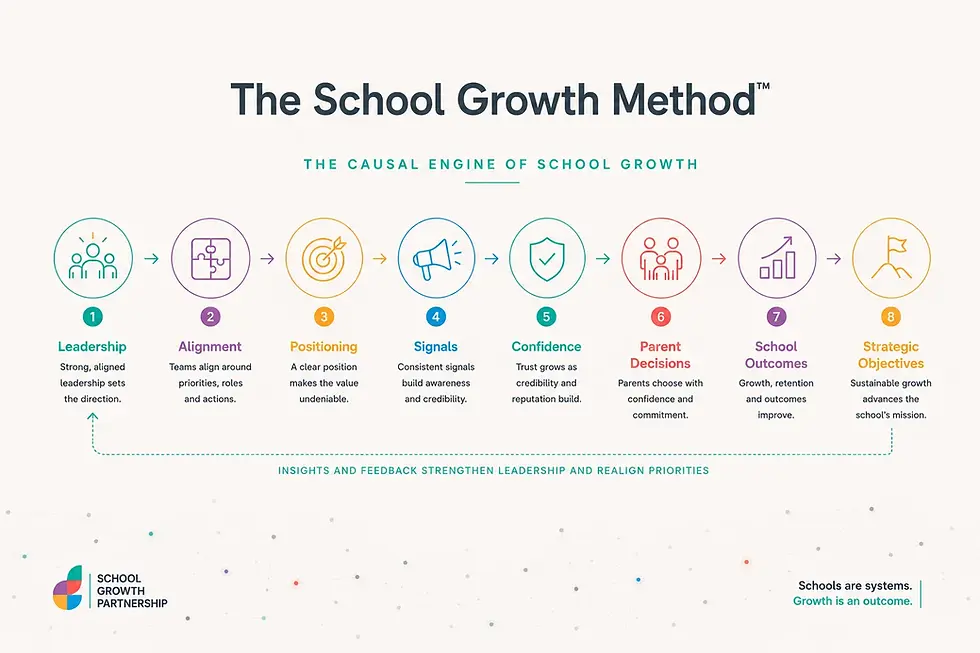
Leadership does not matter simply because it appears first in the sequence. It matters because every later part of the system depends on the conditions leadership creates. Alignment determines whether the school knows what it stands for, who it serves and what it must consistently communicate and deliver. Positioning turns that alignment into a clear promise. Signals are the visible evidence families experience through the website, marketing, admissions, communication, leadership behaviour, visits, parent experience and reputation.
Those signals either build or erode confidence.
Confidence shapes parent decisions. Parents decide whether to enquire, visit, apply, enrol, stay, recommend or leave based on the confidence they have accumulated. Those decisions produce school outcomes. Those outcomes determine whether the school is achieving its strategic objectives.
This is why the Method does not treat marketing, admissions or retention as separate problems. They are different parts of the same engine.
Why Diagnosis Comes First
When a school is under pressure, the instinct is often to act quickly.
Commission a new website. Run more campaigns. Rewrite the prospectus. Change the admissions process. Improve follow-up. Launch a new open day. Hire an agency.
Some of those actions may eventually be right. But without diagnosis, they are guesses.
The Method asks a different question first:
Where is the real constraint?
The constraint may be visibility. Families may not be finding the school. It may be positioning. Families may see the school but not understand why it is the right choice. It may be signals. The website, tour, communication or parent experience may not confirm the promise. It may be admissions. Confidence may not transfer into action. It may be retention. Families may join but not continue choosing the school. It may be leadership alignment. Different parts of the school may be sending different messages.
Until the constraint is identified, effort can increase without performance improving.
What Parents Experience
Parents do not experience a school in departments.
They experience one school.
A family may first encounter the school through search, a recommendation, a social post, a website, a prospectus, a conversation, a visit or a comment from another parent. They do not separate these moments into marketing, admissions, communication and reputation. Each moment becomes part of one judgement: does this school feel clear, credible and right for my child?
That judgement is built through signals.
A fast, thoughtful admissions response is a signal. A confusing website is a signal. A confident tour is a signal. A vague fee conversation is a signal. Existing parents' comments are signals. Leadership communication is a signal. The way the school handles pressure is a signal.
The school's intentions matter less than the evidence families experience.
Evidence and Field Observations
The Method is not based on the idea that every school needs more promotion.
In schools where enquiries are falling, the issue is often not simply demand. It may be that demand is going elsewhere, that the school's message is not compelling enough, or that the digital and admissions journey is not creating confidence quickly enough.
One school may need more visibility. Another may already be visible enough, but families lose confidence because the website, tour, follow-up and parent experience do not confirm the same promise. The symptom looks similar from the outside. The constraint is different.
In schools that are under-enrolled, the visible problem may be the roll number, but the cause may sit across positioning, admissions, retention, leadership or market context.
In schools attempting turnaround, campaigns and operational initiatives often fail when they address symptoms before the school has understood the system that produced them: declining confidence, unclear priorities, inconsistent communication, admissions pressure, retention risk or reputation damage.
In moments of disruption, such as the closure of a nearby school, sudden demand can expose whether the receiving school has the leadership, systems and communication maturity to absorb growth without weakening confidence.
These are field observations rather than universal laws. They are useful because they show the same pattern: school growth depends on the interaction of the system.
How the Method Helps
Once you begin looking at schools this way, different questions naturally emerge.
A problem that looked like marketing may be a positioning constraint. A problem that looked like admissions may be a confidence constraint. A problem that looked like retention may be an experience or leadership-alignment constraint.
The result is not a generic growth plan.
The result is a clearer understanding of what must change first.
For some schools, the priority will be positioning. For others, admissions conversion. For others, retention, communication, reputation, leadership alignment, operational maturity or recovery from decline.
The Method does not assume the same answer for every school.
From Understanding to Diagnosis
Understanding the Method is useful, but it is not the same as knowing where your own school is constrained.
That is the role of diagnosis.
The School Growth Diagnostic is designed to help identify which part of the growth system is limiting the school's ability to achieve its objective. It should come before major intervention, because the right action depends on the real constraint.
If your school is seeing falling enquiries, weak conversion, declining retention, uncertain reputation, under-enrolment or pressure around expansion, the instinct is usually to ask:
"What should we do?"
The School Growth Method asks a different question.
"What is the system trying to tell us?"



Comments